Keystone Academy

What is the Difference Between FRT and FR Cable?

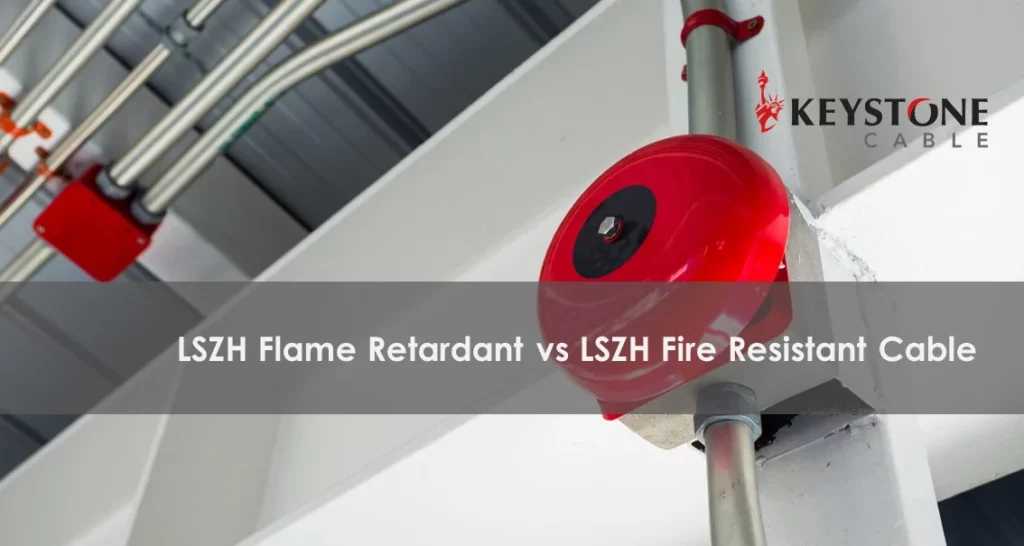
LSZH Flame Retardant (FRT) and LSZH Fire Resistant (FR) cable are two distinct types of cable properties, although these terms are often misused. Flame and Fire can be used interchangeably, but confusion occurs between Retardant and Resistant. Knowing what these cable properties mean can help ensure you get the suitable cable for your application. LSZH Flame Retardant (FRT) Cable LSZH FRT cable is a cable that does not promote the spread of fire. But the cable will not maintain circuit integrity in the presence of fire. The international standards on flame propagation are IEC 60332-1-2 for a single insulated wire or cable or IEC 60332-3 for vertically mounted bunched wires or cables under fire conditions.  To ensure safety during a fire, FRT cable typically uses LSZH material. LSZH produces little smoke or acidic gas when burned**, so LSZH FRT cable also undergoes acid gas emission tests to IEC 60754 or BS EN 60754 and smoke emission tests to IEC 61034 or BS EN 61034.  LSZH FRT cable is a vital cable to be used in enclosed areas with high foot traffic, such as underground passenger systems, airports, schools, hotels, hospitals, and high-rise buildings.  LSZH Fire Resistant (FR) Cable LSZH FR cable is a fire safety product, which means it not only reduces the spread of fire, it will maintain circuit integrity in the presence of fire. FR cable has a layer of mica tape around individual copper conductors. Mica is an incombustible natural inorganic mineral with high dielectric strength and excellent heat resistance. Hence during a fire, the mica acts as a fire barrier to the conductor and maintains circuit integrity. In addition to LSZH FRT tests (IEC 60332, IEC 60754, and IEC 61034), LSZH FR cable is also tested to SS 299, SS299-1, BS 6387, IEC 60331. These tests cover the cable’s resistance to fire, resistance to fire with water and resistance to fire with mechanical shock. LSZH FR cable is an important cable to be used when you require critical electrical installations to perform during a fire evacuation: fire alarm systems, voice alarm systems, and emergency lighting systems. At Keystone, we ensure that our LSZH FR cables fulfil BS 6387 Cat. CWZ provides the highest performance and safety levels for such cables. **What is Low Smoke Zero Halogen (LSZH)?  To understand the properties of LSZH, we compare it to the most commonly used cable material, PVC or polyvinyl chloride. In the event of a fire where PVC burns, black carbon smoke and hydrogen chloride gas (HCl) are released. Black smoke impedes general vision. And when gaseous hydrogen chloride comes in contact with moisture, such as a person’s eyes, mouth, throat and nose, it dissolves to form hydrochloric acid, causing extreme irritation and choking, hindering escape. (CH2CHCl)n + O2 → CO2 + CO + HCl + H2O LSZH, because of inorganic additives such as aluminium hydroxide or magnesium hydroxide, releases gaseous water when burned, which helps envelop the flame and exclude oxygen from the fire. In this chemical reaction, the decomposed products are non-toxic and the mineral phases MgO and Al2O3 are alkaline, reducing the likelihood of acidic gas irritations. When burned, LSZH also emits less optically dense smoke, thus allowing better vision and escape.  Mg(OH)2 → MgO + H2O or 2Al(OH)3 → Al2O3 + 3H2O For more information on LSZH cables, please get in touch with our sales team.

What is the Difference Between FRT and FR Cable? Read More »
Key Principles for Cable Drum Handling and Storage

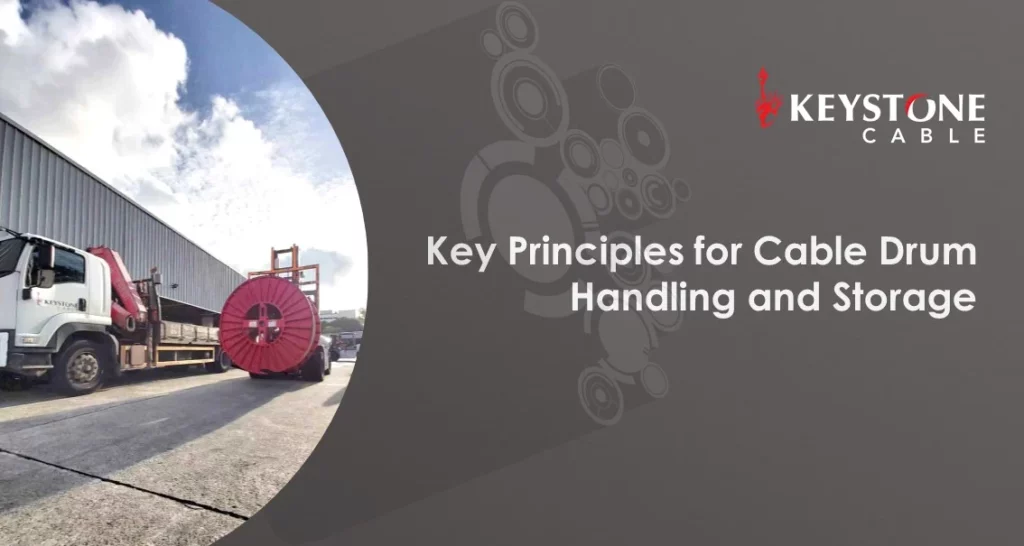
Cable drums are primarily meant to protect the cables from damage and to store cables properly for use. We have summarized some recommendations below for drum handling and storage as we employ these same methods in our factory and warehouse. It is important that cable drums are handled and stored correctly to prevent any unwanted impact or damage to the cables. Damaging cable drums due to mishandling could void your warranty with manufacturers if the cables were compromised. So it is important to take precautions. Handling Drums 1)Never attempt to move a cable drum by dropping the drum, such as from the transport vehicle. This will potentially damage both the drum and cable. Always use proper lifting equipment, such as cranes or forklifts, when moving drums. Storage of Drums 1)Drums should be stored on a hard surface with wedges or barriers to prevent the drums from rolling. 2)If the storage surface is soft or not flat, e.g. soil, it is important to elevate the drum off the ground to prevent the possibility of subjecting the drums to continually damp conditions that could damage the cable or the drum. 3)Avoid storing cable drums lying flat on the side, as this creates unwanted stress on the cable layers at the bottom. Drums should be stored upright. Uncoiling of Cables 1)To uncoil cables, support the drum on a jack stand or the equivalent. When using a stand, always be mindful of pulling the cable from the top, not the bottom, where the cable can scrape against the floor. 2)As aforementioned, avoid laying drums flat on the side. By the same token, avoid uncoiling cables from drums that are laid flat, as this could cause unwanted scratches to the cables against the drum flanges during the uncoiling process. 3)If a cable length has been cut from the drum, the exposed cable end remaining on the drum should be resealed immediately with a heat-shrinkable end cap to prevent any moisture or water ingress. The drum’s protective covering should also be restored where possible. We hope these simple principles help with your drum handling and storage. Feel free to access a more expanded visual guide by clicking the button below. DOWNLOAD GUIDE For more enquiries, please reach out to our team here. Contact Sales

Key Principles for Cable Drum Handling and Storage Read More »

Cable Bending Radius Calculation

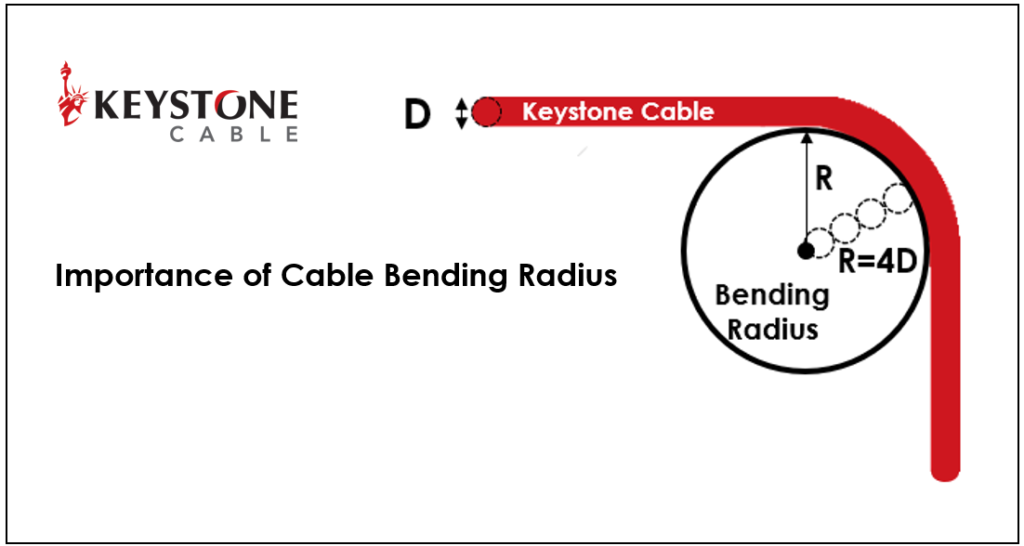
The cable bending radius is the minimum radius a cable can be bent without damaging it. The smaller the bending radius, the greater the flexibility of the material. Knowing your cable’s minimum bending radius will help prevent damage during installation. There are 4 factors that influence the minimum bending radius, including the cable-insulated material, the cable construction, the cable size and the cable’s overall diameter. To install the cables safely without damaging the electrical and physical properties of the cables, the tabulated minimum bending radius must be observed.  For example, you have a Keystone Cable 4Cx16 mm²  CU/XLPE/PVC 0.6/1kV cable. According to our Keystone Building & Infrastructure Cable table: D = 21.4 mm; Bending Radius (R) (Fixed) = 4D = 4 x 21.4 mm = 85.6 mm In addition to the common cable types above, we have summarized the bending radius for multiple cable types in a one-page table, including flexible, control, instrument, thermocouple, bus, welding, HDPE and solar cables. Feel free to download the table reference for your use. Please note that these figures do not represent all manufacturers’ cables and that the data is based on Keystone Cable’s product range. DOWNLOAD TABLE   For more enquiries, please get in touch with the team here. Contact Us

Cable Bending Radius Calculation Read More »

5 Key Factors in Choosing the Right Cable Size [Example + Tables]

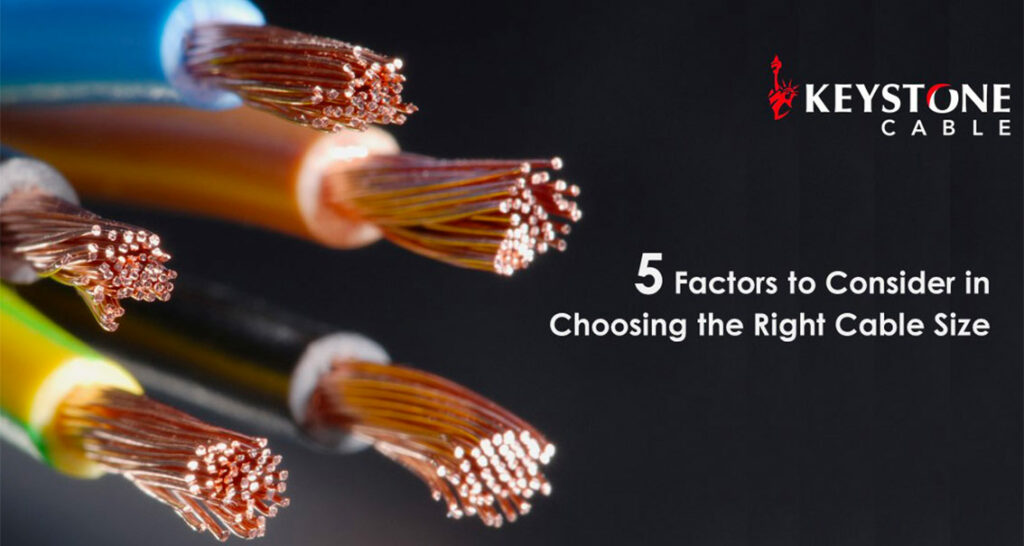
In our line of work, we get many good questions on suitable cable sizes. We have distilled here some of the key considerations we recommend looking into to determine the suitable cable size.  This article primarily references low-voltage power cables with copper conductors. *TIP: To keep the information handy, we also recommend reaching out to our sales team, who will take you through a step-by-step cable sizing example using Current-Carrying Capacity Method, Voltage Drop Method and how to apply the correction factors described in this article. The guide includes a comprehensive list of cable sizing tables for your calculation references.  The guiding principle in choosing the right cable size is how well your cable can carry the required current load in your installation environment without causing excessive voltage drop from your supply voltage. Once you know the load the cable will carry (Ampere), here are some conditions that would affect the ultimate cable size you choose. Going through the considerations below may bring you to different recommended conductor sizes. The key is that the minimum conductor size you select must at least be the minimum allowable cable size that can cover all the conditions you have looked into. With that in mind, here are five questions we would typically ask: 1. Installation Method This is the first thing we look at because how and where the cable will be installed directly affects whether a cable could be overloaded (e.g. in conduit, on cable tray, in free air, grouping, spacing, trefoil, laid flat). Generally, the more enclosed the cables are (e.g. in conduit versus. in free air), the more you may need to use a larger cable size to ensure it can withstand the current and allow proper heat dissipation. 2. Cable Material  Cable insulation material (the extruded layer after the conductor) is important in cable sizing because it directly affects your cable’s maximum operating temperature. For your reference, we have placed common insulation materials: PVC, XLPE, and EPR in the guide.  In standard cable materials, PVC has a maximum operating temperature of 70˚C, XLPE 90 ˚C and EPR 90 ˚C. You may wonder why, for instance, we would choose PVC vs XLPE, given the lower maximum operating temperature for PVC. This relates to other material properties that work better in your installation environment. For instance, PVC is much more flexible than XLPE and may be a better choice where you would require the cable to bend in tighter spaces.  You may also choose between single-core or multi-core cables depending on the installation requirement, which would also affect the current carrying capacity of the cable. A single-core cable would be able to dissipate heat better than a multi-core cable and hence would have a higher current carrying capacity. However, you may still choose the multi-core cable as installing the required conductors at go could be easier. 3. Cable Length We require cable length to assess Voltage Drop, which is the loss of electrical potential along your cable run. In Singapore, we follow the SS638 (formerly known as CP5) wiring regulations, where the voltage drop of a cable run must not exceed 4%. For instance, if a supply voltage is 415V, then the maximum permissible voltage drop cannot exceed 4% of 415V = 16.6V The cable size and length of a cable line mainly determine the voltage drop of a circuit. The smaller the cable size or, the longer the cable length required for your circuit, the greater the voltage loss. If you find that the voltage drop of the circuit has exceeded the 4% stated, you would need to upsize your cable. 4. Ambient Temperature Our tables assume a standard ambient temperature of 30˚C in free air or a ground temperature of 15˚C with a depth of 0.5m. Do note that cable routing and ventilation will directly affect your ambient temperature, so it is important to consider the installation condition along the entire length of the cable laid. If there is a deviation from the standard temperature, you must apply a correction factor to the current load your cable is expected to carry. The higher your ambient temperature from the standard, the larger your cable size may be needed to carry the required load.  5. Number of circuits Our tables assume that you are laying one circuit single-phase or three-phase. If you intend to group circuits in your installation, it is crucial to apply a cable grouping correction factor so that you select the appropriate cable size that would prevent overheating issues. The more circuits you intend to group, the harder the heat dissipation; hence you may need to upsize the cables accordingly.  We hope this article has given you a general idea of some key factors to consider when determining the minimum allowable cable size. To reiterate, you may choose the minimum economic size to cover all the conditions you have looked into to ensure the cable does not get overloaded. To help with your cable size estimates, please refer to the free guide below, where we take you through a step-by-step example and include cable sizing tables for your calculations.  For more information, please contact us.

5 Key Factors in Choosing the Right Cable Size [Example + Tables] Read More »

Scroll to Top