
YSLY and YSLCY
- YSLY (YY) → Unscreened flexible control cable
- YSLCY (CY) → Screened flexible control cable with copper braid
Understanding this helps bridge the gap between what is written in a datasheet and what is used on the ground.
What are Control Cables?
Control cables are designed to transmit signals and low voltage control circuits, not to carry main electrical power.
They are commonly used in:
- Automation systems
- Control panels
- Manufacturing equipment
- Instrumentation systems
Why Flexibility Matters
Unlike fixed power cables, control cables often need to:
- Be routed through tight spaces
- Bend around panels and equipment
- Be installed and replaced easily
This is why they are made with fine stranded copper conductors, allowing them to flex without breaking.
Cable Construction
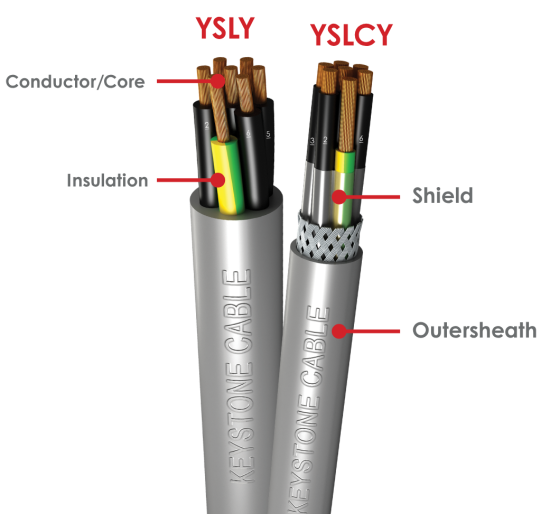
To understand how YSLCY and YSLY cables perform, it helps to look at how they are built.
Conductor (Core)
- Carries the electrical signal.
- Made of fine stranded copper (usually Class 5) for flexibility.
Insulation
- Keeps signals separated.
- Most commonly PVC (cost-effective for general use).
- Can also be XLPE or specialised compounds for higher temperature needs.
Shield
- Protects against electrical noise.
- Made of tinned copper braid to reduce electromagnetic interference (EMI) and protect signal quality.
Outer Sheath
- Protects from physical and environmental damage.
- Typically PVC, providing resistance against abrasion, oil, and moisture.
Difference between YSLY and YSLCY
The main difference comes down to shielding.
| Cable Feature |
YY / YSLY |
CY / YSLCY |
Shielding |
No shielding (unscreened) | Tinned copper braid (screened) |
EMI Protection |
No | Yes |
| Flexibility | Flexible | Flexible |
Cost |
Lower | Higher |
Typical Use |
General purpose control | Noisy electrical environments |
When Should You Use YSLY or YSLCY?
In industrial environments, equipments such as motors, variable frequency drives (VFDs), and power cables generate electromagnetic noise. This noise can interfere with nearby control cables and affect signal reliability.
This leads to a practical rule of thumb:
| Cable |
YY / YSLY |
CY / YSLCY |
|
Criteria |
|
|
Typical Applications |
|
|
Keystone Multi-Core Flexible Control Cables
Our oil-resistant variants are also VDE certified, ensuring compliance with recognised factory standard cable requirements for industrial environments.
All cables undergo stringent testing, including tensile and elongation tests, to ensure consistent flexibility and mechanical durability in real-world operating conditions.
If you are unsure which cable suit your application, please reach out to us.